AI Functions for AIoT-Enabled Water Treatment & Distribution
AI-Powered Identification and Location Functions for Water Utility Operations
AI and IoT Functions for Personnel, Access, Asset, Inventory, and Traceability Management Across Water Treatment Facilities
UtilityWater AI applies AI and IoT identification and location technologies to help water utilities improve workforce visibility, secure facility access, locate critical assets, manage operational resources, and maintain digital records across treatment plants, pump stations, distribution networks, and field operations.
Contact UsAI and IoT Connecting People, Assets, and Operations in Water Utilities
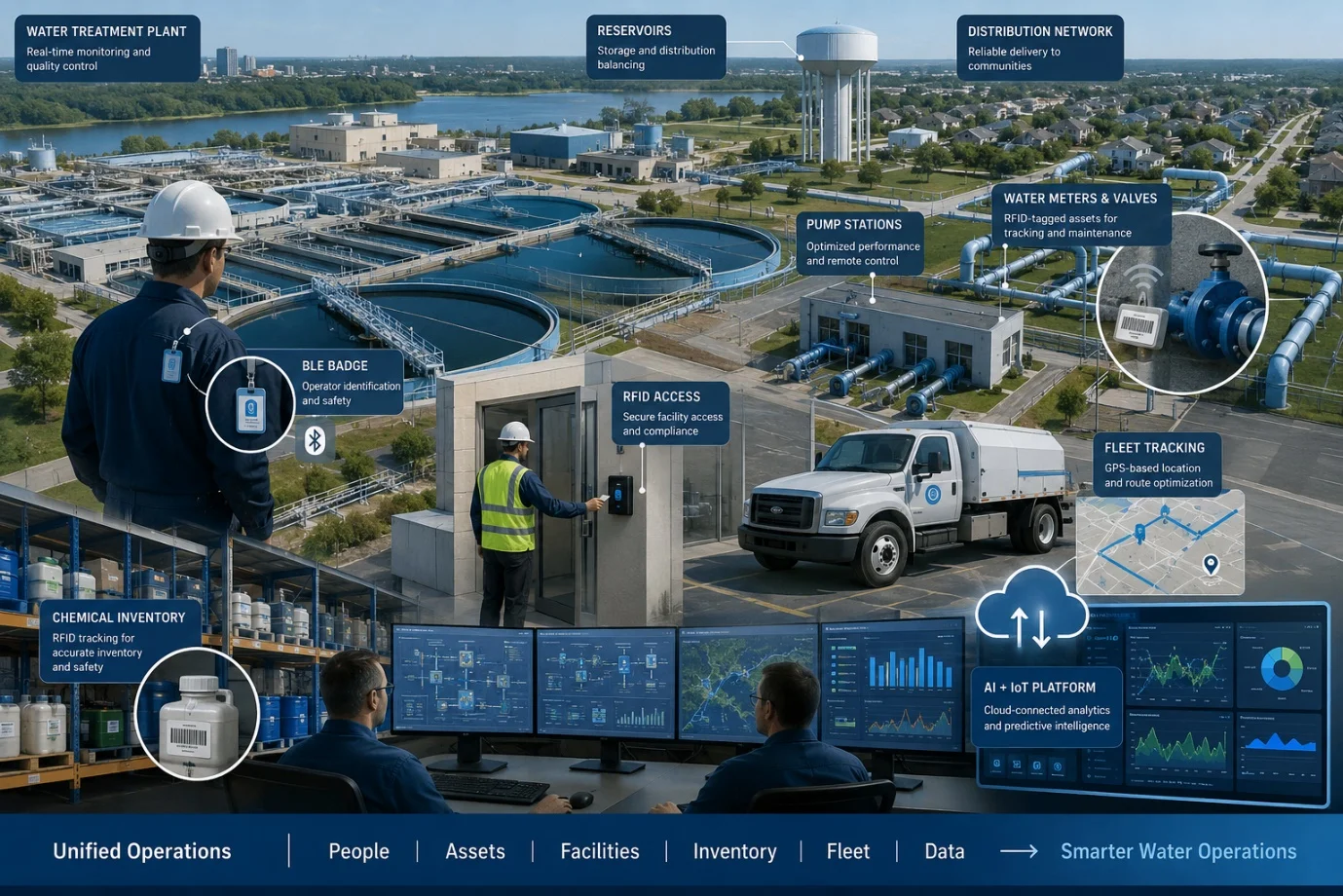
Shows how AI and IoT technologies unify workforce identification, facility access control, asset tracking, inventory management, fleet operations, and utility workflows across a municipal water treatment and distribution network. The key takeaway is that a centralized AI-powered platform provides real-time visibility, operational intelligence, compliance support, and coordinated management of people, assets, facilities, and critical infrastructure.
Overview of AI Functions for Water Treatment & Distribution
Water treatment and distribution organizations manage complex operational environments where personnel, infrastructure, equipment, vehicles, inventory, and regulated materials must be coordinated across multiple locations.
A typical utility may operate:
- Drinking water treatment plants
- Pump stations
- Reservoir facilities
- Booster stations
- Transmission pipelines
- Distribution networks
- Maintenance yards
- Chemical storage buildings
- Warehouses
- Laboratory facilities
- Emergency response locations
Maintaining accurate information about where people, equipment, and materials are located is essential for safe operations, maintenance efficiency, emergency response, and regulatory documentation.
AI and IoT functions combine artificial intelligence software with connected identification technologies, including RFID, Bluetooth Low Energy (BLE), GPS, LoRaWAN, and cellular communication. These technologies enable utilities to automatically identify operational resources, analyze movement patterns, support workflow decisions, and improve visibility across distributed infrastructure.
UtilityWater AI focuses on identification and location solutions rather than environmental measurement systems. The primary objective is helping water utilities answer critical operational questions:
- Where are authorized personnel working?
- Who has entered restricted operational areas?
- Where are critical pumps, valves, meters, and maintenance tools located?
- Are required chemicals and spare parts available?
- Can operational activities be verified through digital records?
By applying AI and IoT functions to these challenges, utilities can improve accountability, reduce manual processes, and strengthen operational reliability.
Core AI and IoT Functions for Water Treatment & Distribution
UtilityWater AI organizes AI-enabled functions around five operational priorities:
- Workforce location management
- Secure facility access
- Asset location and utilization
- Chemical and parts inventory management
- Process and operational traceability
The highest-value applications focus on personnel, access, assets, and inventory because these areas directly affect daily utility operations. Traceability functions provide additional support for compliance reporting, maintenance documentation, and operational history.
Workforce Location Management
Operator Location Management
Water treatment operators, maintenance technicians, contractors, and emergency response teams frequently move between operational areas. Traditional sign-in sheets, radio communication, and manual tracking processes can make it difficult to maintain accurate awareness of personnel locations.
AI and IoT workforce location management provides utilities with improved visibility into personnel movement across treatment facilities and operational sites.
BLE personnel badges, RFID identification, and location software can support:
- Operator identification
- Facility presence tracking
- Work area verification
- Contractor accountability
- Emergency response coordination
- Workforce activity records
For example, a treatment plant operator entering a filtration building, chemical handling area, or pump room can be automatically identified through authorized location systems. This creates a digital record of personnel presence without requiring manual logging.
AI software can analyze operational patterns to help supervisors understand workforce utilization, improve shift planning, and identify opportunities for workflow improvements.
Confined Space Worker Tracking
Water utilities frequently operate infrastructure that includes confined spaces such as:
- Storage tanks
- Wet wells
- Pump chambers
- Valve vaults
- Underground utility structures
- Treatment process areas
Confined space activities require strict worker accountability and emergency preparedness. AI and IoT identification solutions help utilities maintain awareness of workers entering and exiting controlled areas.
Capabilities include:
- Worker entry verification
- Personnel identification
- Location confirmation
- Time-based activity records
- Emergency personnel accountability
- Contractor tracking
BLE badges and RFID credentials can provide digital records that support confined space procedures while helping supervisors verify worker status during critical activities.
These systems complement existing safety procedures by improving information availability during routine maintenance and emergency situations.
Lone Worker Protection
Water distribution networks often require technicians to work independently at remote locations, including:
- Remote pump stations
- Reservoir sites
- Pipeline inspection locations
- Valve maintenance areas
- Rural service territories
AI and IoT lone worker solutions improve accountability by combining personnel identification, location information, and automated alerts.
Applications include:
- Worker location confirmation
- Scheduled check-in management
- Unexpected inactivity detection
- Emergency notification workflows
- Response coordination
When a worker requires assistance, location information can help supervisors and response teams determine where support is needed.
This capability is particularly valuable for utilities managing geographically distributed infrastructure where response time and location accuracy are important.
Shift Compliance Analytics
Water utilities operate continuous processes that require reliable staffing coverage. Treatment operations, maintenance activities, and emergency response functions often depend on scheduled personnel availability.
AI and IoT workforce systems help organizations analyze:
- Shift attendance
- Facility presence
- Work area assignments
- Personnel movement history
- Contractor activity
- Operational coverage
AI-based analysis can identify patterns that support workforce planning and operational improvements.
Examples include:
- Confirming that required personnel are present during operating periods
- Verifying contractor activity during maintenance projects
- Reviewing workforce coverage during emergency events
- Supporting operational documentation requirements
Digital shift records reduce dependence on manual reporting while improving visibility into daily utility activities.
AI and IoT Workforce Identification Workflow for Water Treatment Facilities
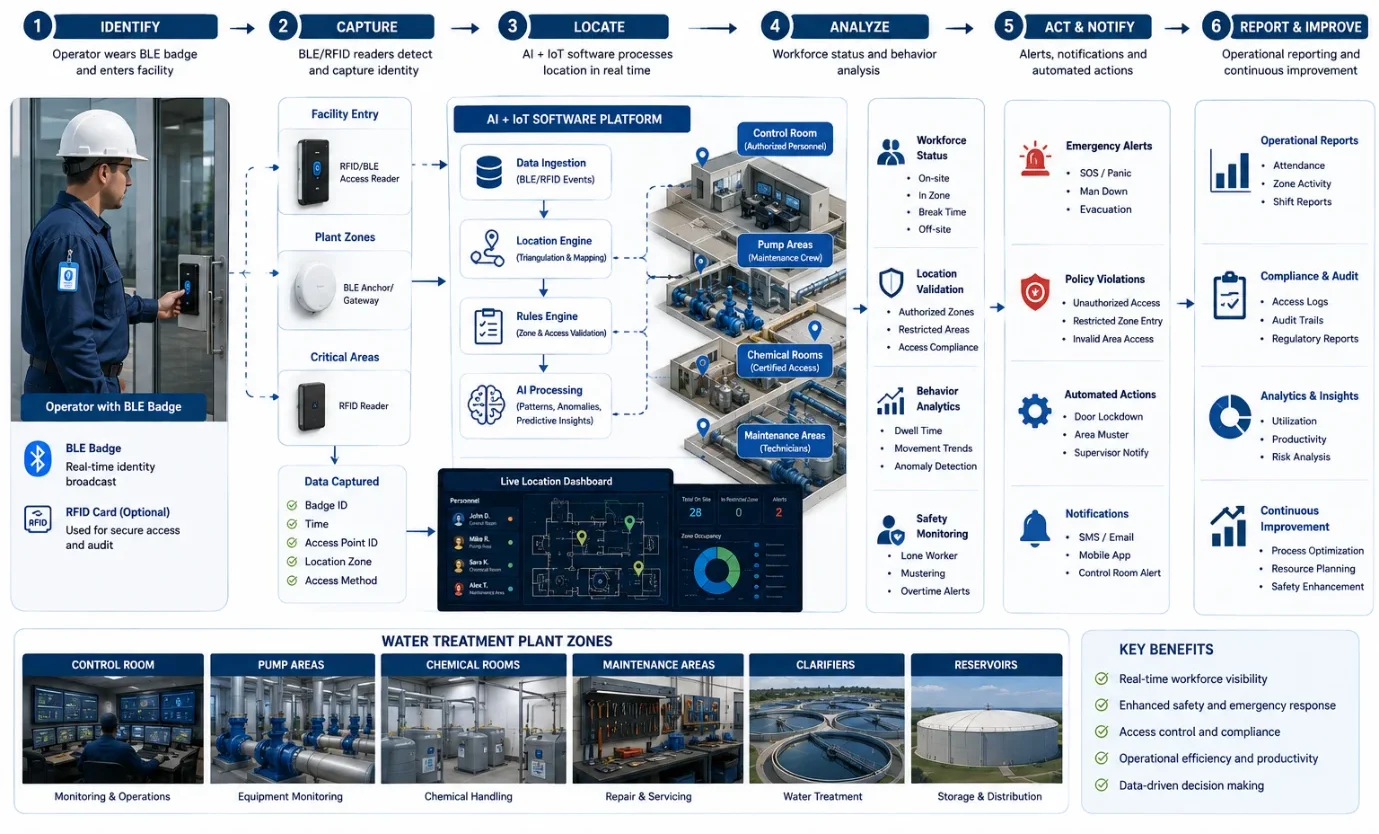
This workflow diagram illustrates how water treatment personnel are identified through BLE badges and RFID credentials as they enter and move throughout operational zones, including control rooms, pump areas, chemical rooms, and maintenance facilities. The AI and IoT platform processes location and access data to provide workforce visibility, safety monitoring, emergency alerts, compliance reporting, and operational insights. The key takeaway is that digital workforce identification improves safety, accountability, regulatory compliance, and operational efficiency across water utility operations.
Secure Facility Access for Water Treatment Operations
Water treatment and distribution facilities contain critical infrastructure that requires controlled access, operational accountability, and reliable identification of authorized personnel. Treatment plants, pump stations, chemical storage buildings, laboratories, electrical rooms, and control areas often have different access requirements based on operational responsibilities and safety procedures.
Traditional access management methods may rely on physical keys, manual visitor logs, or standalone access systems. These approaches can create challenges when utilities need to verify who entered a specific area, when access occurred, and whether personnel had appropriate authorization.
AI and IoT secure facility access solutions combine digital credentials, RFID identification, BLE personnel badges, access readers, and AI-based software analysis to improve access control across water utility environments.
UtilityWater AI supports utilities by enabling:
- Digital identification of employees and contractors
- Automated access event recording
- Restricted area verification
- Visitor activity documentation
- Facility entry analytics
- Operational compliance reporting
These capabilities help utilities strengthen security while maintaining efficient access for authorized personnel.
Treatment Plant Access Analytics
Water treatment plants contain multiple operational zones with different levels of access requirements.
Examples include:
- Raw water intake areas
- Chemical handling facilities
- Filtration buildings
- Disinfection areas
- Pump rooms
- Electrical facilities
- SCADA control rooms
- Laboratory spaces
- Maintenance workshops
AI and IoT access solutions provide utilities with digital records of facility entry activity.
Access analytics can help organizations understand:
- Who accessed a specific area
- When access occurred
- Whether access matched assigned responsibilities
- Frequency of facility visits
- Contractor activity history
- Operational area utilization
AI software can analyze access records to identify unusual patterns, such as unexpected entry times, repeated unauthorized attempts, or access events outside normal operating schedules.
These insights help utilities improve security procedures while supporting operational investigations and compliance documentation.
Restricted Zone Access Verification
Certain water treatment areas require additional controls because of operational, safety, or security requirements.
Restricted areas may include:
- Chemical storage rooms
- Chlorination facilities
- Electrical substations
- Control centers
- Laboratory areas
- Pump control rooms
- Critical infrastructure locations
AI and IoT access verification combines identity information with location-based rules to confirm that only authorized personnel enter specific areas.
Supported functions include:
- Credential verification
- Authorized personnel recognition
- Entry event logging
- Restricted area alerts
- Access history reporting
For example, a maintenance technician may be authorized to enter a pump room but not a chemical storage facility. AI and IoT software can verify credentials against assigned permissions before recording access activity.
This approach improves operational security while reducing dependence on manual verification processes.
Digital Credential Validation
Water utilities frequently manage access for:
- Full-time employees
- Maintenance contractors
- Engineering teams
- Inspection personnel
- Emergency responders
- Temporary workers
Digital credential validation helps organizations maintain accurate authorization records.
Supported technologies include:
- RFID access credentials
- BLE personnel badges
- Mobile identification credentials
- Electronic access readers
Credential validation systems can support:
- Employee identity verification
- Contractor access management
- Credential expiration tracking
- Access permission updates
- Digital audit records
These capabilities help utilities maintain stronger control over facility access while simplifying administrative processes.
Visitor Access Risk Assessment
Visitors and contractors frequently require access to water utility facilities for:
- Equipment inspections
- Construction activities
- Maintenance projects
- Engineering assessments
- Regulatory reviews
AI and IoT visitor management solutions help utilities document and manage temporary access.
Capabilities include:
- Visitor identification
- Entry authorization
- Escort verification
- Location records
- Visit history reporting
AI-based analysis can help identify access patterns that require review, such as repeated temporary access requests or visits outside expected schedules.
This supports better operational security while maintaining efficient collaboration with external organizations.
Asset Location and Utilization Management
Water treatment and distribution organizations manage thousands of physical assets distributed across facilities and service territories.
Critical assets include:
- Pumps
- Motors
- Valves
- Flow meters
- Portable generators
- Maintenance equipment
- Repair tools
- Utility vehicles
- Inspection equipment
- Emergency response equipment
Knowing the location and availability of these assets is essential for maintenance planning, emergency response, and operational continuity.
AI and IoT asset location solutions combine identification technologies with software systems to provide improved visibility into asset movement and utilization.
Supported technologies include:
- RFID asset tags
- BLE asset identification
- GPS fleet tracking
- LoRaWAN asset connectivity
- Cellular tracking solutions
UtilityWater AI helps utilities reduce time spent searching for equipment, improve maintenance coordination, and create more accurate asset records.
Pump Station Asset Tracking
Pump stations are critical components of water distribution networks. These facilities may be distributed across large geographic areas and often contain valuable equipment requiring regular inspection and maintenance.
AI and IoT asset tracking helps utilities manage:
- Pump assemblies
- Motors
- Control equipment
- Portable maintenance tools
- Replacement components
- Emergency equipment
Benefits include:
- Faster asset identification
- Improved maintenance preparation
- Better equipment availability
- Digital asset movement records
- Improved service response
When maintenance teams need equipment for emergency repairs, accurate asset location information can reduce delays and improve response coordination.
Valve and Water Meter Tracking
Water distribution systems include thousands of valves, meters, and related infrastructure components.
Managing these assets requires accurate identification throughout their lifecycle.
AI and IoT identification solutions support:
- Valve location records
- Meter identification
- Installation documentation
- Maintenance history tracking
- Replacement tracking
- Field verification
RFID identification can simplify asset verification during inspections and maintenance activities by allowing field teams to quickly confirm equipment identity.
This improves accuracy compared with manual records that may become outdated over time.
Fleet Vehicle Location Management
Water utilities operate diverse fleets that support daily operations and emergency response.
Examples include:
- Service trucks
- Maintenance vehicles
- Vacuum trucks
- Excavation equipment
- Inspection vehicles
- Emergency response vehicles
GPS-based AI and IoT fleet tracking provides visibility into vehicle location and operational activity.
Capabilities include:
- Vehicle location tracking
- Route history
- Dispatch coordination
- Fleet utilization analysis
- Maintenance scheduling support
- Emergency response coordination
AI software can analyze fleet activity to support more efficient deployment of vehicles and field personnel.
For example, during a water main break, dispatch teams can identify nearby available vehicles and coordinate response resources more effectively.
Predictive Asset Maintenance Support
Water utilities depend on reliable equipment operation. Unexpected failures involving pumps, motors, valves, or mobile equipment can interrupt service and increase maintenance costs.
AI and IoT asset identification supports predictive maintenance programs by connecting asset identity with operational history.
Supported information includes:
- Asset location
- Maintenance records
- Service history
- Replacement history
- Inspection documentation
AI analysis can help maintenance teams prioritize activities by identifying assets requiring attention based on available operational records.
This supports a proactive maintenance approach that improves equipment availability and extends asset lifecycle management.
Chemical & Parts Inventory Management
Water treatment and distribution operations depend on reliable availability of chemicals, spare parts, repair materials, and maintenance supplies. Inventory accuracy directly affects treatment continuity, emergency response capability, maintenance scheduling, and regulatory readiness.
Utilities commonly manage:
- Water treatment chemicals
- Disinfection materials
- Pipe repair components
- Valves and fittings
- Pump replacement parts
- Electrical components
- Mechanical supplies
- Laboratory materials
- Personal protective equipment
- Maintenance tools
Manual inventory processes can create challenges such as inaccurate stock records, delayed replenishment, misplaced materials, and limited visibility across multiple facilities.
AI and IoT inventory management solutions combine identification technologies such as RFID, BLE, and connected software systems to improve inventory accuracy across treatment plants, warehouses, maintenance facilities, and chemical storage locations.
UtilityWater AI supports inventory workflows by enabling:
- Digital identification of materials
- Location tracking of inventory items
- Automated inventory records
- Stock level visibility
- Replenishment planning
- Inventory movement history
- Maintenance material availability tracking
These capabilities help utilities maintain operational readiness while reducing administrative effort.
Chemical Inventory Optimization
Water treatment facilities manage chemicals that require careful storage, handling, and documentation.
Common treatment chemicals include:
- Disinfectants
- Coagulants
- pH adjustment chemicals
- Corrosion control materials
- Water treatment additives
AI and IoT identification solutions help utilities maintain accurate records of chemical containers, storage locations, and material movement.
Supported functions include:
- Chemical container identification
- Storage location tracking
- Inventory status updates
- Material usage documentation
- Replenishment planning
- Handling record management
RFID identification can allow operators to quickly verify chemical inventory information without relying solely on manual documentation.
AI-based analysis can help identify usage patterns and support better planning for seasonal demand, emergency situations, and operational changes.
Spare Parts Demand Forecasting
Water utilities maintain extensive inventories of spare parts to support preventive maintenance and emergency repairs.
Examples include:
- Pump seals
- Motor components
- Valve assemblies
- Meter replacement parts
- Pipe fittings
- Electrical components
- Control equipment parts
AI and IoT inventory systems can analyze historical inventory movement and maintenance records to improve forecasting.
Supported capabilities include:
- Historical usage analysis
- Maintenance-related demand analysis
- Stock level evaluation
- Replacement planning
- Inventory priority classification
Improved forecasting helps utilities balance two operational priorities:
- Maintaining sufficient spare parts availability
- Avoiding unnecessary inventory costs
Automated Replenishment Support
Maintaining the correct inventory level is essential for continuous water operations.
AI and IoT inventory solutions can support replenishment workflows by providing:
- Low-stock notifications
- Inventory location verification
- Purchase planning information
- Material availability reports
- Supplier coordination records
For example, when a maintenance warehouse reaches a predefined stock level for critical valve components or repair materials, the system can notify responsible personnel.
This reduces the likelihood of delays during planned maintenance or emergency response activities.
Warehouse Stock Analytics
Water utility warehouses often contain thousands of items supporting field operations.
AI and IoT warehouse solutions improve visibility by tracking:
- Incoming materials
- Stored inventory
- Equipment checkout
- Returned materials
- Maintenance consumption
- Inventory location
Warehouse teams can improve:
- Material retrieval speed
- Inventory accuracy
- Equipment accountability
- Maintenance preparation
Digital inventory records also support better coordination between warehouses, treatment plants, and field service teams.
Process and Operational Traceability Tracking
Water utilities require accurate operational records to support maintenance activities, internal procedures, and regulatory reporting.
Traceability involves understanding:
- What activity occurred
- Where it occurred
- Which personnel performed the activity
- Which equipment was involved
- When the activity occurred
- Which materials were used
AI and IoT traceability solutions connect identification information with operational workflows to create more complete digital records.
UtilityWater AI supports traceability applications through:
- Personnel identification
- Asset identification
- Inventory tracking
- Workflow documentation
- Digital reporting
These capabilities improve operational transparency while reducing dependence on manual records.
Treatment Stage Progress Tracking
Water treatment includes multiple operational stages requiring coordinated activities and documentation.
Examples include:
- Intake operations
- Treatment processing
- Filtration activities
- Disinfection procedures
- Storage operations
- Distribution activities
AI and IoT identification solutions help utilities associate personnel, equipment, and workflow activities with specific operational stages.
Supported functions include:
- Operator activity records
- Equipment identification
- Maintenance verification
- Workflow status updates
- Operational documentation
This helps organizations maintain accurate records of completed activities while improving coordination between teams.
Chain of Custody Verification
Water utilities may require documented handling records for materials, samples, equipment, and regulated operational activities.
AI and IoT solutions support chain of custody workflows through:
- Digital identification
- Time-stamped records
- Location verification
- Personnel association
- Movement history
Applications include:
- Laboratory sample tracking
- Equipment movement documentation
- Chemical handling records
- Maintenance material tracking
Accurate identification records help utilities demonstrate accountability throughout operational processes.
Water Quality Traceability Documentation
Although UtilityWater AI focuses on identification and location solutions rather than environmental measurement, AI and IoT systems can support documentation workflows associated with water quality operations.
Examples include:
- Linking operational activities to locations
- Associating maintenance records with equipment
- Tracking laboratory-related assets
- Documenting responsible personnel
- Supporting inspection preparation
These records provide operational context that helps utilities maintain organized documentation.
Regulatory Compliance Documentation
Water utilities must maintain detailed records for regulatory reviews, internal audits, safety programs, and operational management.
AI and IoT traceability solutions support compliance documentation through:
- Digital access records
- Asset history records
- Inventory documentation
- Personnel activity records
- Maintenance verification
- Workflow records
Benefits include:
- Faster audit preparation
- Improved record accuracy
- Reduced manual reporting
- Better operational transparency
Digital documentation helps utilities demonstrate that required procedures have been followed and operational activities have been properly recorded.
AI Functions Summary for Water Treatment & Distribution
UtilityWater AI provides AI and IoT functions designed around the operational requirements of water treatment and distribution organizations.
The primary capabilities include:
- Workforce location management for operators, contractors, and field teams
- Secure facility access management for treatment plants and restricted areas
- Asset location solutions for pumps, valves, meters, vehicles, and maintenance equipment
- Inventory management for chemicals, spare parts, and warehouse materials
- Traceability solutions for operational documentation and compliance reporting
By combining AI software with RFID, BLE, GPS, LoRaWAN, and cellular identification technologies, utilities can improve visibility across distributed infrastructure while maintaining compatibility with existing operational processes.
AI and IoT Functions Designed for Utility Operations
Water treatment and distribution requires reliable information about people, equipment, materials, and operational activities.
UtilityWater AI helps organizations address these challenges through practical AI and IoT solutions focused on:
- Improving workforce accountability
- Strengthening facility security
- Increasing asset visibility
- Optimizing inventory processes
- Supporting maintenance coordination
- Improving operational documentation
- Enhancing regulatory readiness
These functions provide a foundation for modern utility operations where accurate identification and location information supports safer, more efficient, and more reliable water services.
Chemical & Parts Inventory Management
Water treatment and distribution operations depend on reliable availability of chemicals, spare parts, repair materials, and maintenance supplies. Inventory accuracy directly affects treatment continuity, emergency response capability, maintenance scheduling, and regulatory readiness.
Utilities commonly manage:
- Water treatment chemicals
- Disinfection materials
- Pipe repair components
- Valves and fittings
- Pump replacement parts
- Electrical components
- Mechanical supplies
- Laboratory materials
- Personal protective equipment
- Maintenance tools
Manual inventory processes can create challenges such as inaccurate stock records, delayed replenishment, misplaced materials, and limited visibility across multiple facilities.
AI and IoT inventory management solutions combine identification technologies such as RFID, BLE, and connected software systems to improve inventory accuracy across treatment plants, warehouses, maintenance facilities, and chemical storage locations.
UtilityWater AI supports inventory workflows by enabling:
- Digital identification of materials
- Location tracking of inventory items
- Automated inventory records
- Stock level visibility
- Replenishment planning
- Inventory movement history
- Maintenance material availability tracking
These capabilities help utilities maintain operational readiness while reducing administrative effort.
Chemical Inventory Optimization
Water treatment facilities manage chemicals that require careful storage, handling, and documentation.
Common treatment chemicals include:
- Disinfectants
- Coagulants
- pH adjustment chemicals
- Corrosion control materials
- Water treatment additives
AI and IoT identification solutions help utilities maintain accurate records of chemical containers, storage locations, and material movement.
Supported functions include:
- Chemical container identification
- Storage location tracking
- Inventory status updates
- Material usage documentation
- Replenishment planning
- Handling record management
RFID identification can allow operators to quickly verify chemical inventory information without relying solely on manual documentation.
AI-based analysis can help identify usage patterns and support better planning for seasonal demand, emergency situations, and operational changes.
Spare Parts Demand Forecasting
Water utilities maintain extensive inventories of spare parts to support preventive maintenance and emergency repairs.
Examples include:
- Pump seals
- Motor components
- Valve assemblies
- Meter replacement parts
- Pipe fittings
- Electrical components
- Control equipment parts
AI and IoT inventory systems can analyze historical inventory movement and maintenance records to improve forecasting.
Supported capabilities include:
- Historical usage analysis
- Maintenance-related demand analysis
- Stock level evaluation
- Replacement planning
- Inventory priority classification
Improved forecasting helps utilities balance two operational priorities:
- Maintaining sufficient spare parts availability
- Avoiding unnecessary inventory costs
Automated Replenishment Support
Maintaining the correct inventory level is essential for continuous water operations.
AI and IoT inventory solutions can support replenishment workflows by providing:
- Low-stock notifications
- Inventory location verification
- Purchase planning information
- Material availability reports
- Supplier coordination records
For example, when a maintenance warehouse reaches a predefined stock level for critical valve components or repair materials, the system can notify responsible personnel.
This reduces the likelihood of delays during planned maintenance or emergency response activities.
Warehouse Stock Analytics
Water utility warehouses often contain thousands of items supporting field operations.
AI and IoT warehouse solutions improve visibility by tracking:
- Incoming materials
- Stored inventory
- Equipment checkout
- Returned materials
- Maintenance consumption
- Inventory location
Warehouse teams can improve:
- Material retrieval speed
- Inventory accuracy
- Equipment accountability
- Maintenance preparation
Digital inventory records also support better coordination between warehouses, treatment plants, and field service teams.
Process and Operational Traceability Tracking
Water utilities require accurate operational records to support maintenance activities, internal procedures, and regulatory reporting.
Traceability involves understanding:
- What activity occurred
- Where it occurred
- Which personnel performed the activity
- Which equipment was involved
- When the activity occurred
- Which materials were used
AI and IoT traceability solutions connect identification information with operational workflows to create more complete digital records.
UtilityWater AI supports traceability applications through:
- Personnel identification
- Asset identification
- Inventory tracking
- Workflow documentation
- Digital reporting
These capabilities improve operational transparency while reducing dependence on manual records.
Treatment Stage Progress Tracking
Water treatment includes multiple operational stages requiring coordinated activities and documentation.
Examples include:
- Intake operations
- Treatment processing
- Filtration activities
- Disinfection procedures
- Storage operations
- Distribution activities
AI and IoT identification solutions help utilities associate personnel, equipment, and workflow activities with specific operational stages.
Supported functions include:
- Operator activity records
- Equipment identification
- Maintenance verification
- Workflow status updates
- Operational documentation
This helps organizations maintain accurate records of completed activities while improving coordination between teams.
Chain of Custody Verification
Water utilities may require documented handling records for materials, samples, equipment, and regulated operational activities.
AI and IoT solutions support chain of custody workflows through:
- Digital identification
- Time-stamped records
- Location verification
- Personnel association
- Movement history
Applications include:
- Laboratory sample tracking
- Equipment movement documentation
- Chemical handling records
- Maintenance material tracking
Accurate identification records help utilities demonstrate accountability throughout operational processes.
Water Quality Traceability Documentation
Although UtilityWater AI focuses on identification and location solutions rather than environmental measurement, AI and IoT systems can support documentation workflows associated with water quality operations.
Examples include:
- Linking operational activities to locations
- Associating maintenance records with equipment
- Tracking laboratory-related assets
- Documenting responsible personnel
- Supporting inspection preparation
These records provide operational context that helps utilities maintain organized documentation.
Regulatory Compliance Documentation
Water utilities must maintain detailed records for regulatory reviews, internal audits, safety programs, and operational management.
AI and IoT traceability solutions support compliance documentation through:
- Digital access records
- Asset history records
- Inventory documentation
- Personnel activity records
- Maintenance verification
- Workflow records
Benefits include:
- Faster audit preparation
- Improved record accuracy
- Reduced manual reporting
- Better operational transparency
Digital documentation helps utilities demonstrate that required procedures have been followed and operational activities have been properly recorded.
AI and IoT Functions Designed for Utility Operations
Water treatment and distribution requires reliable information about people, equipment, materials, and operational activities.
UtilityWater AI helps organizations address these challenges through practical AI and IoT solutions focused on:
- Improving workforce accountability
- Strengthening facility security
- Increasing asset visibility
- Optimizing inventory processes
- Supporting maintenance coordination
- Improving operational documentation
- Enhancing regulatory readiness
These functions provide a foundation for modern utility operations where accurate identification and location information supports safer, more efficient, and more reliable water services.