AI and IoT Integration for Water Treatment & Distribution
Connecting Identification, Location, and Operational Data with Existing Utility Systems
AI and IoT Integration Solutions Connecting Water Utility Operations, Enterprise Software, and Field Infrastructure
UtilityWater AI provides integration software that connects personnel tracking, access control, asset identification, inventory management, and traceability solutions with SCADA, CMMS, ERP, GIS, and other utility systems.
Overview of AI and IoT Integration for Water Utilities
Water treatment and distribution organizations operate complex combinations of industrial control systems, maintenance applications, enterprise software, and field operations tools. Common utility systems include:
- SCADA systems for operational control
- CMMS systems for maintenance management
- ERP systems for resource planning
- GIS systems for infrastructure mapping
- Workforce management systems
- Inventory management systems
- Utility billing systems
AI and IoT integration connects identification and location solutions with these existing systems.
The purpose of integration is not to replace established utility software. Instead, integration adds operational visibility by connecting information about:
- Personnel location
- Facility access
- Asset identification
- Equipment movement
- Inventory activity
- Field service operations
UtilityWater AI focuses on practical integration solutions that allow water utilities to use AI and IoT data within existing operational workflows.
AI and IoT Integration Soulutions for Water Utility Operations
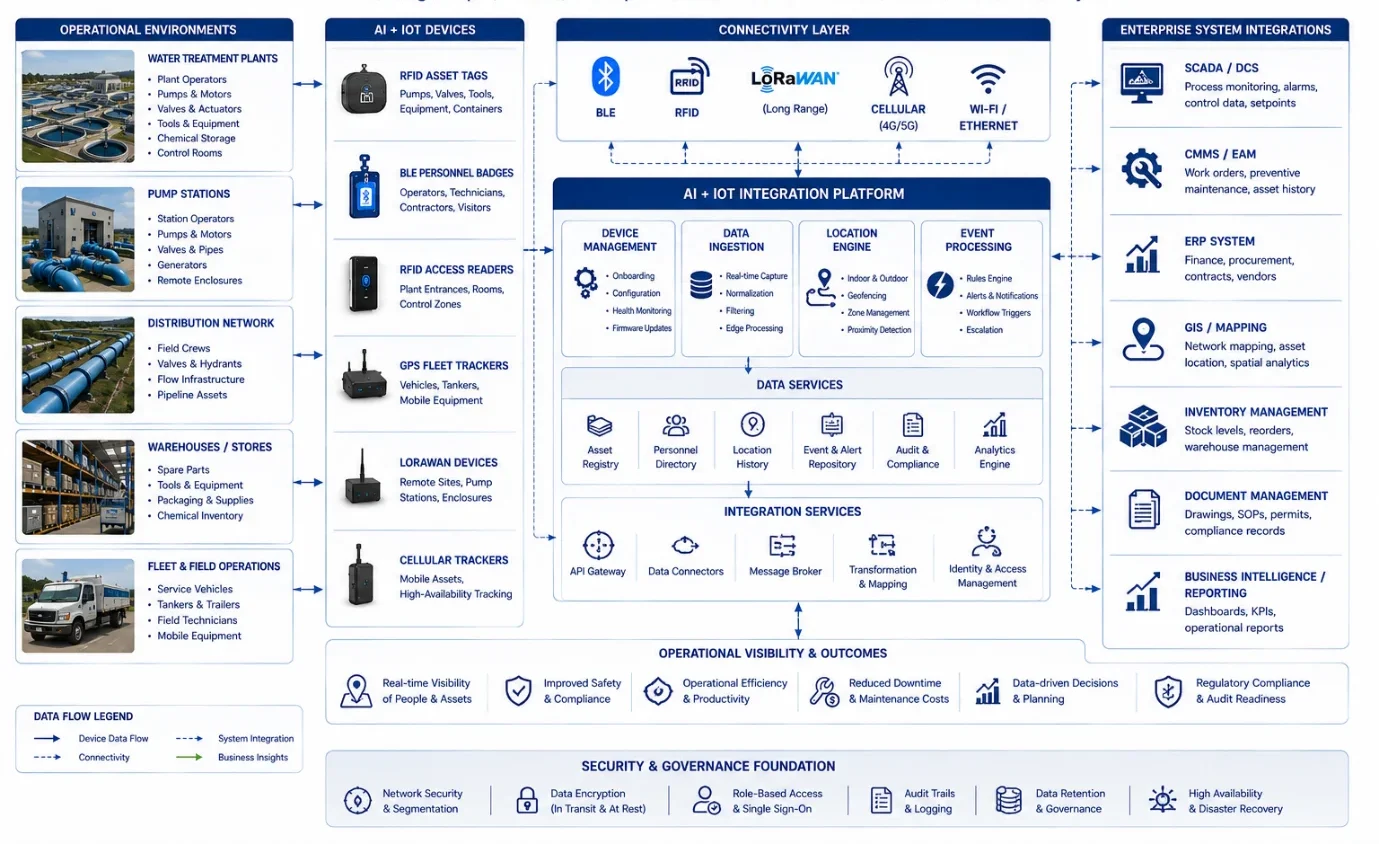
This integration diagram illustrates how AI and IoT identification technologies—including RFID asset tags, BLE personnel badges, GPS fleet trackers, access readers, LoRaWAN devices, and cellular-connected assets—connect through a centralized integration platform to enterprise water utility systems. The system demonstrates seamless data flow between treatment plants, pump stations, warehouses, field operations, SCADA, CMMS, ERP, GIS, inventory management, and reporting applications, enabling unified operational visibility, compliance, maintenance coordination, and data-driven decision-making across the utility network.
Middleware & Interoperability
Middleware provides the connection layer between AI and IoT solutions and existing utility applications.
Water utilities often operate systems from multiple vendors. Integration software helps exchange information between these systems while maintaining operational consistency.
Middleware solutions support:
- Data exchange
- System communication
- Information transformation
- Workflow coordination
- Application connectivity
Data Synchronization Software
Data synchronization software helps maintain consistency between AI and IoT solutions and existing utility databases.
Applications include:
- Asset information synchronization
- Personnel record updates
- Inventory information exchange
- Location data sharing
- Maintenance record updates
Examples:
- A newly identified pump asset can be synchronized with an asset management system.
- A technician’s completed work activity can be associated with an existing maintenance record.
- Inventory movement can be shared with warehouse management systems.
Benefits include:
- Reduced duplicate data entry
- Improved record consistency
- Faster information availability
- Better coordination between departments
System Interoperability Layer
System interoperability software enables communication between different utility applications.
Water utilities may need to connect:
- AI and IoT software
- SCADA systems
- CMMS applications
- ERP software
- GIS systems
- Access control systems
The interoperability layer supports:
- Data format conversion
- Application communication
- Workflow integration
- Secure information exchange
This allows utilities to maintain existing technology investments while adding new identification and location capabilities.
Edge Processing Software
Edge processing software supports local processing of AI and IoT information near operational locations.
Applications include:
- Treatment facilities
- Pump stations
- Remote infrastructure
- Industrial facilities
Edge processing can support:
- Local data processing
- Faster operational response
- Reduced communication requirements
- Improved reliability during connectivity interruptions
Examples include:
- Processing access events at a treatment facility
- Managing local equipment identification records
- Supporting remote location workflows
Edge processing is especially useful where immediate operational decisions are required.
Deployment Models for AI and IoT Utility Integration
Water utilities have different requirements based on operational policies, security requirements, and existing IT environments.
UtilityWater AI supports multiple deployment approaches.
Cloud SaaS Deployment
Cloud software deployment allows utilities to access AI and IoT integration services through centralized infrastructure.
Applications include:
- Multi-site utility operations
- Distributed treatment facilities
- Fleet management
- Enterprise reporting
Benefits include:
- Centralized software management
- Remote access
- Easier expansion across locations
- Simplified software maintenance
Cloud deployment is suitable for utilities requiring visibility across multiple facilities and service regions.
Server Software Deployment
Server-based deployment allows organizations to operate AI and IoT software within their own IT environments.
Applications include:
- Utilities with internal data policies
- Organizations requiring local hosting
- Facilities with controlled network environments
Benefits include:
- Internal infrastructure management
- Organization-controlled data handling
- Integration with existing enterprise systems
- Local operational management
Server deployment provides flexibility for utilities with specific information technology requirements.
Enterprise System Connectivity
AI and IoT integration becomes more valuable when connected with the systems already used by utility organizations.
SCADA Integration Software
SCADA systems provide operational control and supervisory functions for water treatment processes.
AI and IoT integration can enhance SCADA environments by providing additional identification information.
Applications include:
- Associating equipment records with physical assets
- Linking maintenance activities with locations
- Supporting operational documentation
- Improving asset visibility
Integration allows operational teams to access identification information alongside existing process information.
ERP & CMMS Connectivity
ERP and CMMS systems manage critical business and maintenance operations.
AI and IoT integration can support:
- Asset record updates
- Maintenance workflow improvements
- Inventory coordination
- Equipment history tracking
- Work order association
Examples:
- A technician scans an RFID-tagged pump component.
- The system identifies the asset and connects the activity with the CMMS work order.
- Inventory records are updated after replacement materials are used.
This improves consistency between field operations and enterprise records.
Utility Billing Integration
Utility billing systems primarily support customer service and revenue management.
Although billing systems operate separately from identification solutions, integration can support broader utility information management.
Potential applications include:
- Linking service areas with infrastructure information
- Supporting field service coordination
- Improving information consistency between departments
Integration helps utilities maintain better alignment between customer operations and infrastructure management.
AI and IoT Integration Benefits for Water Utilities
Integration enables utilities to connect operational information across departments and systems.
Key benefits include:
- Improved information consistency
- Reduced manual data entry
- Better asset visibility
- Faster maintenance coordination
- Improved inventory management
- Stronger operational records
- Better reporting capability
- Easier system expansion
AI and IoT integration helps utilities gain more value from existing software investments while adding identification and location capabilities.
UtilityWater AI Integration Approach
UtilityWater AI provides integration solutions designed for water treatment and distribution environments.
The integration approach focuses on:
- Connecting AI and IoT identification solutions
- Supporting existing utility software
- Improving operational workflows
- Maintaining flexible deployment options
- Enabling secure data exchange
Supported integration areas include:
- Personnel identification systems
- Access management systems
- Asset tracking systems
- Inventory software
- Fleet management systems
- SCADA environments
- CMMS systems
- ERP applications
UtilityWater AI is developed within Aperture Venture Studio, with support from GAO. Based on two decades of IoT experience, GAO has served thousands of IoT customers and delivered thousands of IoT projects. UtilityWater AI incorporates this experience through research and development investments, quality assurance processes, and technical support delivered remotely or onsite.
The company’s technical teams include Ph.D. professionals from leading universities and have supported Fortune 500 organizations, research institutions, universities, and government agencies.
Evaluate AI and IoT Integration Opportunities
UtilityWater AI helps water treatment and distribution organizations evaluate integration requirements including:
- Existing software systems
- Facility operations
- Identification technologies
- Connectivity requirements
- Deployment preferences
Contact UtilityWater AI to explore integration solutions connecting personnel, assets, inventory, and operational records across water utility environments.
Contact Us