
AI and IoT Hardware Technologies for Water Treatment Operations
Identification Hardware for Water Utility Personnel, Assets, Facilities, and Operations
AI and IoT Hardware Technologies Enabling Identification and Location Solutions Across Water Treatment Facilities
UtilityWater AI combines RFID, BLE, GPS, LoRaWAN, and cellular hardware technologies with AI and IoT software to help water utilities identify personnel, secure facilities, locate critical assets, manage fleet operations, and maintain operational traceability.
Overview of AI and IoT Hardware for Water Treatment Operations
Water treatment and distribution organizations operate complex infrastructure that requires accurate identification and location information. Hardware technologies provide the physical connection between operational resources and AI and IoT software systems.
Unlike traditional monitoring approaches focused on environmental measurements, UtilityWater AI emphasizes identification and location hardware designed to answer operational questions:
- Where are personnel working?
- Who has entered a controlled facility?
- Where are pumps, valves, meters, and maintenance tools located?
- Which vehicles are available for field response?
- Where are critical inventory items stored?
AI and IoT hardware technologies combine identification devices, communication technologies, and software connectivity to support operational workflows.
Common hardware components include:
- RFID asset tags
- BLE personnel badges
- GPS fleet trackers
- Access control readers
- RFID identification devices
- BLE location devices
- LoRaWAN communication devices
- Cellular tracking devices
These technologies can be deployed across treatment plants, pump stations, warehouses, maintenance facilities, and distribution networks.
AI and IoT Hardware Technologies for Water Utility Operations
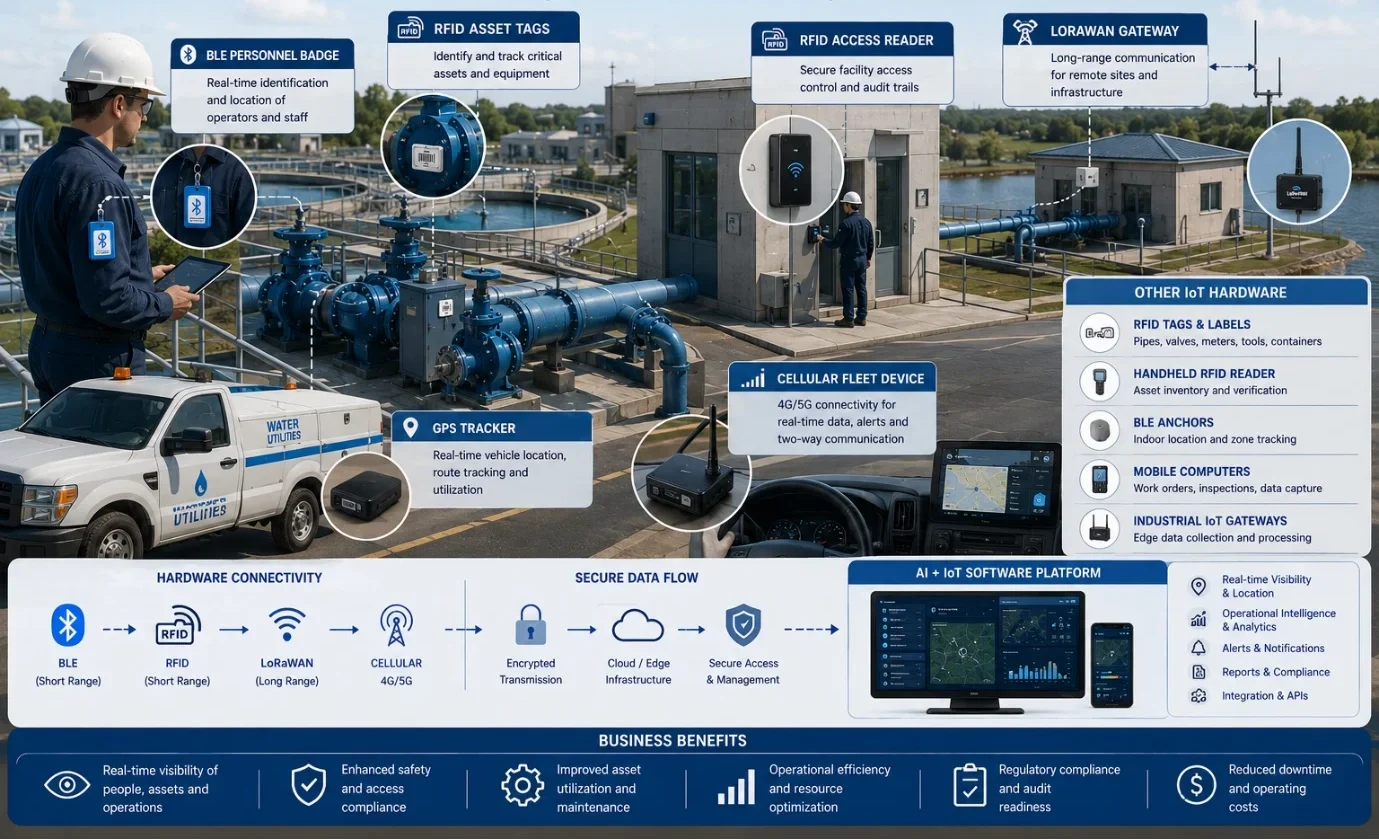
This hardware technology overview showcases the key AI and IoT devices used across water treatment and distribution operations, including RFID asset tags, BLE personnel badges, GPS fleet trackers, RFID access readers, LoRaWAN gateways, and cellular-connected field devices. The diagram demonstrates how these technologies connect people, assets, facilities, and vehicles to a centralized AI and IoT platform, enabling real-time visibility, operational efficiency, regulatory compliance, and improved asset management throughout the utility network.
Physical Identification Devices for Water Utilities
Physical identification devices provide the foundation for AI and IoT identification solutions. These devices allow utilities to assign digital identities to people, equipment, vehicles, and materials.
RFID Asset Tags
RFID asset tags provide a practical method for identifying water utility equipment and inventory.
Common applications include:
- Pump identification
- Valve identification
- Meter tracking
- Maintenance equipment management
- Spare parts identification
- Warehouse inventory control
RFID tags can be attached to:
- Mechanical equipment
- Electrical components
- Portable tools
- Repair materials
- Storage containers
Benefits include:
- Faster asset identification
- Reduced manual data entry
- Improved asset records
- Better maintenance documentation
- Easier inventory verification
For large water utilities managing thousands of assets, RFID provides a scalable method for maintaining consistent identification records.
BLE Personnel Badges
BLE personnel badges support workforce identification and location management within treatment facilities and operational buildings.
Applications include:
- Operator identification
- Contractor management
- Restricted area tracking
- Emergency accountability
- Workforce location support
BLE badges communicate with compatible location systems to provide information about personnel presence in defined areas.
Typical applications include:
- Treatment plant buildings
- Pump facilities
- Maintenance areas
- Chemical handling locations
- Control rooms
BLE personnel identification helps utilities improve operational awareness while supporting workforce safety procedures.
GPS Fleet Trackers
GPS fleet trackers support outdoor location management for utility vehicles and mobile equipment.
Applications include:
- Service vehicles
- Maintenance trucks
- Emergency response vehicles
- Inspection vehicles
- Mobile equipment
GPS hardware provides:
- Vehicle location information
- Route history
- Fleet utilization data
- Dispatch support
- Operational coordination
For utilities managing large geographic service territories, GPS fleet tracking improves communication between field teams and operations centers.
Access Control Readers
Access control readers support secure facility entry management.
Common locations include:
- Treatment plant entrances
- Chemical storage buildings
- Pump stations
- Control rooms
- Maintenance facilities
Access readers can support:
- RFID credentials
- BLE credentials
- Digital identification
- Entry record generation
These devices help utilities maintain accurate access histories and improve control over critical infrastructure.
AI and RFID Technologies for Water Utility Operations
RFID technology provides reliable identification capabilities across utility environments. When combined with AI and IoT software, RFID systems can support:
- Asset identification
- Inventory management
- Maintenance documentation
- Access verification
- Operational reporting
AI RFID Asset Tracking
AI RFID asset tracking helps utilities maintain visibility of equipment throughout its lifecycle.
Supported applications include:
- Pump tracking
- Valve identification
- Tool management
- Spare part management
- Warehouse operations
AI software can analyze RFID identification records to improve:
- Asset utilization
- Equipment availability
- Maintenance planning
- Inventory accuracy
AI RFID Access Credentials
AI RFID access credentials support secure identification of authorized personnel.
Applications include:
- Employee access
- Contractor access
- Visitor management
- Restricted area verification
The system can maintain:
- Credential history
- Entry records
- Permission information
- Access reports
This improves security documentation for water treatment facilities.
AI and BLE Technologies for Water Treatment Operations
BLE technology is widely used for short-range identification and location applications.
AI BLE Personnel Tracking
AI BLE personnel tracking supports:
- Operator identification
- Workforce location
- Facility presence verification
- Emergency accountability
The technology is suitable for environments where employees move between multiple operational areas.
AI BLE Proximity Detection
AI BLE proximity detection helps utilities understand relationships between personnel, equipment, and operational zones.
Applications include:
- Worker presence verification
- Equipment checkout areas
- Restricted zone awareness
- Maintenance coordination
BLE provides a practical approach for improving location awareness within facilities.
Technology Comparison: RFID, BLE, GPS, LoRaWAN & Cellular for Water Utilities
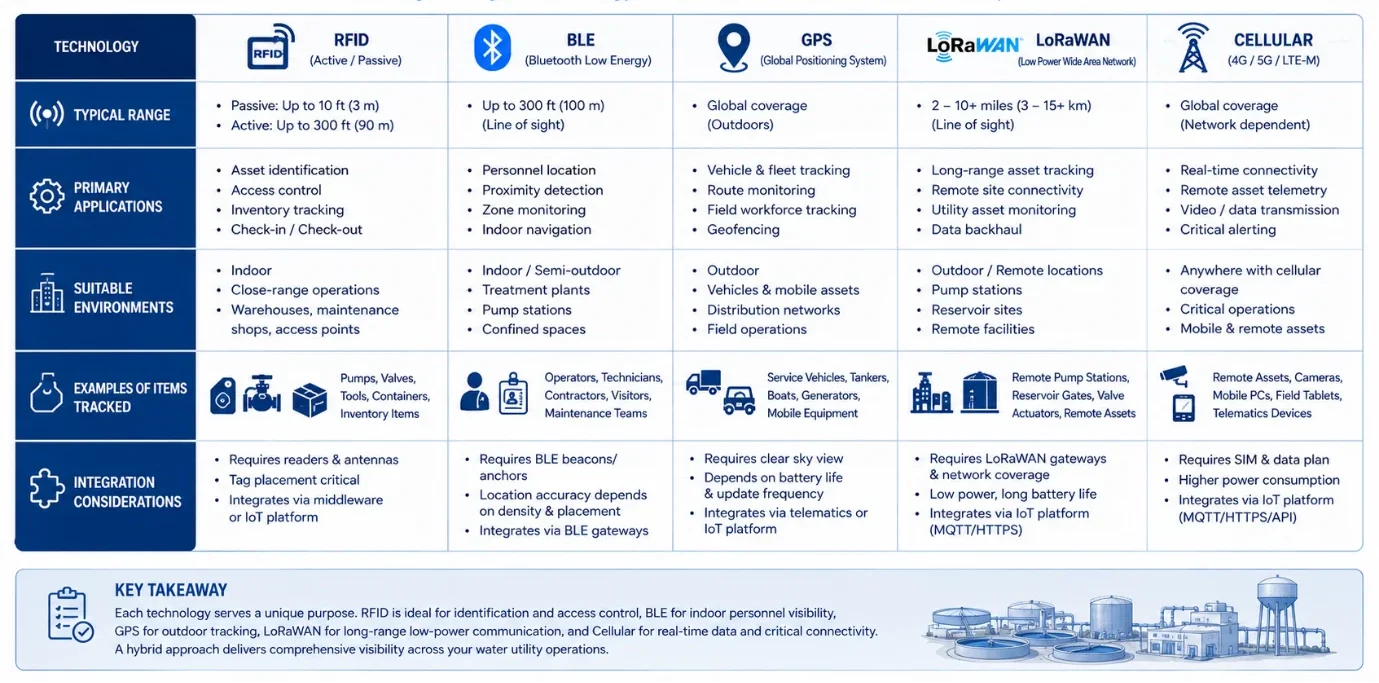
This technology comparison table evaluates RFID, BLE, GPS, LoRaWAN, and cellular connectivity across key criteria including communication range, primary applications, operating environments, tracked assets, and integration requirements. The comparison demonstrates how each technology serves a distinct role within water treatment and distribution operations, with the greatest operational visibility achieved through a combined, multi-technology AI and IoT system.
AI and GPS Technologies for Water Utility Operations
Water utilities often manage assets and personnel across large geographic areas, including treatment facilities, reservoirs, pump stations, distribution networks, and remote service locations.
GPS-based hardware provides location information for outdoor operational environments where traditional indoor identification technologies may not be suitable.
When combined with AI and IoT software, GPS technologies support:
- Fleet location management
- Remote asset identification
- Field team coordination
- Geofencing applications
- Service route management
- Emergency response support
AI GPS Fleet Tracking
AI GPS fleet tracking supports water utility vehicle management by connecting GPS hardware with software-based analysis.
Common tracked vehicles include:
- Maintenance trucks
- Inspection vehicles
- Emergency response vehicles
- Service vans
- Utility trailers
- Mobile equipment
GPS fleet tracking solutions provide:
- Real-time vehicle location information
- Historical route records
- Vehicle utilization analysis
- Dispatch coordination
- Service territory visibility
AI-based software analysis can help utilities identify operational patterns, such as:
- Frequently used service routes
- Vehicle availability trends
- Response activity patterns
- Fleet utilization opportunities
This information helps field supervisors coordinate maintenance activities more effectively.
AI GPS Geofencing Control
AI GPS geofencing control uses virtual geographic boundaries to support operational management.
Water utility applications include:
- Treatment facility boundaries
- Pump station locations
- Service territories
- Maintenance zones
- Equipment storage areas
The system can support:
- Vehicle arrival records
- Departure notifications
- Location-based workflow triggers
- Field activity documentation
For example, a utility can verify when a maintenance vehicle arrives at a remote pump station and associate the activity with a scheduled service task.
GPS geofencing helps improve coordination between centralized operations teams and distributed field personnel.
AI and LoRaWAN Technologies for Remote Water Infrastructure
Water utilities frequently operate infrastructure in remote or difficult-to-access locations.
Examples include:
- Remote pump stations
- Reservoir facilities
- Distribution infrastructure
- Rural service areas
- Isolated utility assets
LoRaWAN technology provides long-range wireless communication suitable for selected remote identification and location applications.
AI LoRaWAN Asset Monitoring
AI LoRaWAN asset solutions support identification and location management where traditional connectivity options may be limited.
Applications include:
- Remote equipment identification
- Distributed asset management
- Infrastructure location records
- Maintenance coordination
The technology can support:
- Low-power connected devices
- Long-distance communication
- Remote facility connectivity
- Extended deployment periods
AI software can analyze identification information and operational records to support asset management decisions.
AI LoRaWAN Remote Tracking
AI LoRaWAN remote tracking supports utilities managing geographically distributed infrastructure.
Applications include:
- Remote equipment locations
- Field asset management
- Mobile equipment tracking
- Remote maintenance coordination
Benefits include:
- Improved visibility of remote assets
- Reduced manual inspection requirements
- Better field planning
- More organized asset records
LoRaWAN solutions are especially useful when utilities require long-range communication with limited infrastructure availability.
AI and Cellular Technologies for Water Utility Operations
Cellular connectivity provides broad geographic coverage for mobile and remote utility applications.
Cellular-based AI and IoT hardware is commonly used for:
- Fleet tracking
- Remote facility connectivity
- Mobile equipment identification
- Field operations support
AI Cellular Fleet Connectivity
AI cellular fleet connectivity supports utility vehicles operating throughout large service areas.
Applications include:
- Vehicle location management
- Field team coordination
- Dispatch support
- Route documentation
Cellular connectivity enables continuous communication between mobile assets and centralized software systems.
AI Cellular Remote Site Tracking
AI cellular remote site tracking supports distributed utility infrastructure.
Applications include:
- Remote pump station identification
- Mobile equipment tracking
- Field service documentation
- Infrastructure management
Cellular-connected devices can provide reliable communication where utilities require wider geographic coverage.
Selecting the Right AI and IoT Hardware Technology
Water treatment and distribution organizations must select hardware based on operational requirements, facility characteristics, and existing infrastructure.
Key considerations include:
Operating Environment
Different utility environments require different hardware approaches.
Examples:
- Indoor treatment buildings may use BLE identification
- Equipment yards may use RFID or GPS solutions
- Mobile vehicles may use GPS and cellular connectivity
- Remote facilities may require LoRaWAN or cellular communication
Identification Range Requirements
The required operating distance influences technology selection.
Examples:
- RFID supports close-range identification
- BLE supports facility-level personnel location
- GPS supports outdoor geographic tracking
- LoRaWAN supports long-range remote communication
- Cellular supports wide-area connectivity
Asset Type and Mobility
Utilities should evaluate whether resources are:
- Fixed infrastructure
- Portable equipment
- Mobile vehicles
- Personnel
- Inventory materials
Examples:
- Pumps and valves may require RFID identification
- Field vehicles may require GPS tracking
- Operators may use BLE badges
- Remote assets may use LoRaWAN connectivity
Integration Requirements
Hardware should support connection with existing utility software systems.
Common integration targets include:
- Asset management software
- CMMS systems
- SCADA environments
- ERP systems
- Workforce management systems
UtilityWater AI supports hardware integration strategies that connect identification devices with operational software.
AI and IoT Hardware Deployment Examples in Water Treatment & Distribution
AI and IoT hardware technologies can be applied across multiple operational areas.
Water Treatment Plants
Applications include:
- Operator identification
- Restricted area access control
- Equipment identification
- Maintenance tool tracking
- Inventory management
Technologies commonly used:
- BLE personnel badges
- RFID asset tags
- RFID access readers
- Indoor location systems
Pump Stations and Remote Facilities
Applications include:
- Remote equipment identification
- Vehicle arrival tracking
- Maintenance activity documentation
- Facility access records
Technologies commonly used:
- GPS tracking devices
- Cellular connectivity
- LoRaWAN devices
- RFID identification
Distribution Network Field Operations
Applications include:
- Service vehicle tracking
- Field team coordination
- Equipment location management
- Work activity documentation
Technologies commonly used:
- GPS fleet trackers
- BLE personnel badges
- RFID equipment tags
- Cellular-connected devices
Utility Warehouses and Maintenance Facilities
Applications include:
- Spare parts identification
- Material location management
- Tool tracking
- Inventory verification
Technologies commonly used:
- RFID tags
- RFID readers
- BLE location systems
Hardware Technology Benefits for Water Utilities
AI and IoT hardware solutions help utilities improve operational visibility through reliable identification and location capabilities.
Key benefits include:
- Faster asset identification
- Improved personnel visibility
- Better facility access records
- More accurate inventory information
- Improved fleet coordination
- Stronger operational documentation
- Better support for maintenance activities
- Improved remote infrastructure visibility
By selecting appropriate hardware technologies and connecting them with AI and IoT software, water utilities can create practical identification solutions that support daily operations.
UtilityWater AI Hardware Technology Approach
UtilityWater AI provides AI and IoT hardware solutions designed around real operational requirements in water treatment and distribution environments.
The company combines:
- RFID identification technologies
- BLE location technologies
- GPS tracking technologies
- LoRaWAN communication solutions
- Cellular connectivity solutions
with software systems for:
- Personnel management
- Access control
- Asset tracking
- Inventory management
- Traceability documentation
UtilityWater AI is created within Aperture Venture Studio, with support from GAO. Building on two decades of IoT experience, GAO has supported thousands of IoT customers and executed thousands of IoT projects. UtilityWater AI incorporates this experience with investments in research and development, quality assurance processes, and technical support provided remotely or onsite.
The team includes Ph.D. professionals from leading universities and has supported Fortune 500 companies, research organizations, universities, and government agencies.
Request an AI and IoT Hardware Assessment
UtilityWater AI helps water treatment and distribution organizations evaluate hardware technologies based on:
- Facility requirements
- Asset categories
- Location requirements
- Connectivity conditions
- Software integration needs
Contact UtilityWater AI to discuss identification and location solutions for treatment plants, pump stations, distribution networks, warehouses, and field operations.
U.S. and Canadian Standards and Regulations for AI and IoT-Enabled Water Treatment & Distribution
- Safe Drinking Water Act (SDWA)
- Clean Water Act (CWA)
- America’s Water Infrastructure Act (AWIA) of 2018
- Water Infrastructure Finance and Innovation Act (WIFIA)
- EPA Water Sector Cybersecurity Best Practices
- EPA Cybersecurity Evaluation Program for Water Utilities
- EPA Risk and Resilience Assessment Requirements
- EPA Emergency Response Plan Requirements
- EPA National Primary Drinking Water Regulations (NPDWR)
- EPA National Secondary Drinking Water Regulations (NSDWR)
- EPA Water Quality Standards Regulation
- EPA Industrial Control Systems Cybersecurity Guidance
- EPA Cross-Sector Cybersecurity Performance Goals (CPGs)
- NIST Cybersecurity Framework (CSF)
- NIST Special Publication 800-82 Guide to Industrial Control Systems (ICS) Security
- NIST Special Publication 800-61 Computer Security Incident Handling Guide
- NIST Artificial Intelligence Risk Management Framework (AI RMF)
- NIST Privacy Framework
- ISO/IEC 27001 Information Security Management Systems
- ISO/IEC 27002 Information Security Controls
- ISO/IEC 27701 Privacy Information Management Systems
- ISO 42001 Artificial Intelligence Management System
- IEC 62443 Industrial Automation and Control Systems Security
- IEC 62676 Video Surveillance Systems
- IEC 61131 Programmable Controllers
- ISA-95 Enterprise-Control System Integration
- ISA-18.02 Management of Alarm Systems for the Process Industries
- AWWA G430 Security Practices for Operations and Management
- AWWA G440 Emergency Preparedness Practices
- AWWA G430-22 Security Practices for Operations and Management
- AWWA M5 Water Utility Management Practices
- AWWA M22 Sizing Service Lines and Meters
- AWWA M36 Water Audits and Loss Control Programs
- AWWA M41 Ductile-Iron Pipe and Fittings
- AWWA Cybersecurity Guidance and Standards
- AWWA Water Sector Cybersecurity Risk Management Guidance
- AWWA Utility Management Standards
- UL 2900 Software Cybersecurity Assurance
- UL 294 Access Control System Units
- UL 2610 Commercial Premises Security Alarm Units and Systems
- UL 1076 Proprietary Burglar Alarm Units and Systems
- FCC Part 15 Radio Frequency Devices
- FCC Part 22 Public Mobile Services
- FCC Part 24 Personal Communications Services
- FCC Part 25 Satellite Communications
- FCC Part 96 Citizens Broadband Radio Service
- Bluetooth SIG Qualification Requirements
- EPCglobal RFID Standards
- GS1 RFID Standards
- ISO/IEC 18000 RFID Air Interface Standards
- ISO/IEC 15693 RFID Standards
- ISO/IEC 14443 RFID Standards
- ISO/IEC 18000-63 UHF RFID Standards
- LoRaWAN Alliance Technical Specifications
- 3GPP Cellular IoT Standards
- LTE-M Standards
- NB-IoT Standards
- Canadian Environmental Protection Act (CEPA)
- Canadian Environmental Assessment Act
- Canada Water Act
- Fisheries Act (Canada)
- Guidelines for Canadian Drinking Water Quality
- Health Canada Drinking Water Quality Guidelines
- Canadian Centre for Cyber Security Guidance
- Cyber Security Framework for Critical Infrastructure in Canada
- CSA Z1600 Emergency Management and Business Continuity
- CSA Z1002 Occupational Health and Safety Hazard Identification and Elimination
- CSA C22.1 Canadian Electrical Code
- CSA ISO/IEC 27001 Information Security Management Systems
- CAN/CSA-ISO/IEC 27002 Information Security Controls
Top Players in AI and IoT for Water Treatment & Distribution
- Xylem
- SUEZ
- Veolia
- Evoqua Water Technologies
- Emerson Electric
- Rockwell Automation
- Siemens
- Schneider Electric
- Honeywell
- ABB
- AVEVA
- Bentley Systems
- Trimble
- Autodesk
- Hexagon AB
- Oracle
- SAP
- IBM
- Microsoft
- Zebra Technologies
- GAO RFID
- Impinj
- Honeywell International
- SATO Holdings
- Alien Technology
- Zebra MotionWorks
- Johnson Controls
- ASSA ABLOY
- HID Global
- Bosch Security Systems
- Motorola Solutions
- Sonitor Technologies
- Geotab
- Samsara
- Verizon Connect
- Trimble Transportation
- Garmin
- CalAmp
- Semtech
- Actility
- MultiTech Systems
- Cisco
- Ericsson
- Nokia
- Quectel Wireless Solutions
- Cityworks
- Cartegraph
- Infor
- Oracle Utilities
- Esri
Case Studies for AI and IoT-Enabled Water Treatment & Distribution
Chicago, Illinois
AI and IoT Personnel Location and Asset Tracking System for Municipal Water Treatment Operations
Problem
A municipal water treatment organization required improved visibility of field personnel, maintenance teams, and critical operational assets across multiple treatment facilities. The organization managed complex daily activities involving water treatment processes, equipment inspections, maintenance tasks, chemical handling areas, and restricted operational zones.
Existing operational procedures relied heavily on manual coordination, paper-based records, and communication between supervisors and field teams. These methods created challenges in quickly identifying the location of authorized personnel, confirming access to controlled areas, and locating mobile equipment used for treatment plant operations.
The organization required an AI and IoT solution focused on identification and location capabilities rather than traditional monitoring. Key requirements included:
- Real-time identification of personnel working across treatment plant areas
- Improved visibility of maintenance staff during routine and emergency activities
- Location-based access verification for restricted operational zones
- Identification and tracking of portable maintenance equipment
- Integration capabilities with existing utility operational software
The solution needed to support water treatment environments where reliable communication, durable hardware, and operational security were essential.
Solution
UtilityWater AI implemented an AIoT-enabled personnel and asset identification solution using BLE and RFID technologies provided through GAO Tek Inc. and GAO RFID Inc. experience in IoT deployments.
The deployed solution combined BLE personnel location capabilities with RFID-based asset identification to support water treatment operations.
The implementation included:
- BLE personnel badges for identifying authorized operators, maintenance personnel, and contractors
- BLE gateways positioned across treatment facility areas to collect location information
- RFID tags attached to portable equipment, maintenance tools, and operational assets
- RFID readers for asset identification during equipment movement and inventory activities
- AI and IoT software for location analysis, access records, asset assignments, and operational workflows
For personnel location functions, BLE technology was selected because it provides practical indoor positioning capabilities for large facilities such as treatment plants, pump stations, and chemical storage areas. BLE gateways collected badge information and transferred location data to the software system for operational analysis.
For asset tracking functions, GAO RFID Inc. UHF RFID readers, tags, and accessories were integrated to support identification of equipment and inventory items. UHF RFID technology allowed staff to quickly identify multiple tagged items during maintenance preparation, inventory checks, and equipment transfers.
Relevant hardware categories included:
- BLE Gateways
- Provided wireless communication between personnel badges and the AI and IoT software system
- Supported facility-wide location data collection
- BLE Beacons and Accessories
- Enabled personnel identification in treatment plant zones
- Supported location-based operational workflows
- UHF RFID Readers
- Supported rapid identification of tagged maintenance equipment
- UHF RFID Tags and Accessories
- Provided durable identification for tools, replacement parts, and portable assets
- Edge Computing Devices
- Supported local data processing where facility connectivity requirements required additional reliability
The AI and IoT software integrated location information with operational records to help supervisors understand personnel movement patterns, equipment availability, and access activity. The system supported configurable geofencing rules for restricted areas and provided digital records for operational reviews.
GAO Tek Inc. and GAO RFID Inc. experience with BLE, RFID, and IoT-based systems contributed to selecting appropriate wireless technologies, deployment methods, and integration approaches for industrial environments.
Result
The AI and IoT implementation improved operational visibility across treatment facilities by replacing manual identification processes with digital personnel and asset tracking workflows.
Key operational improvements included:
- Faster identification of personnel locations during facility operations
- Improved control of access activities in restricted treatment areas
- Reduced time required to locate tagged maintenance equipment
- More accurate asset inventory records through RFID identification
- Better documentation of operational activities for internal reviews
A key real-world lesson from the deployment was that water treatment facilities require a combination of technologies rather than a single tracking method. BLE provided practical personnel location capabilities inside facilities, while RFID provided efficient identification of physical assets. Selecting the correct technology based on operational requirements was essential for achieving reliable results.
Denver, Colorado
AI and IoT Asset Identification and Inventory Management System for Water Distribution Field Operations
Problem
A regional water distribution organization required a more efficient method for managing field equipment, replacement parts, and maintenance inventory used across its service area.
The organization maintained a large quantity of operational materials, including valves, fittings, repair components, inspection equipment, and field service tools. Inventory tracking depended on manual processes that made it difficult to maintain accurate records of asset availability and movement between storage locations, maintenance facilities, and field teams.
The organization faced several operational challenges:
- Difficulty locating spare parts during urgent repair activities
- Limited visibility into equipment movement between facilities and field locations
- Manual inventory reconciliation processes
- Challenges maintaining accurate records for maintenance-related assets
- Need for better coordination between warehouse operations and distribution field teams
The organization required an AI and IoT solution capable of supporting inventory identification, asset tracking, and field service coordination.
Solution
UtilityWater AI deployed an AIoT-enabled asset identification and inventory management solution based on RFID, GPS IoT tracking, and wireless connectivity technologies.
The solution incorporated GAO RFID Inc. and GAO Tek Inc. hardware categories to support asset identification and field operations.
The implementation included:
- RFID identification for spare parts, tools, and maintenance equipment
- GPS IoT tracking devices for selected mobile field assets and service vehicles
- RFID readers for warehouse and maintenance facility inventory operations
- IoT software for asset records, inventory status, and movement history
- Wireless connectivity using appropriate communication methods based on deployment locations
RFID technology was used as the primary identification method for inventory management. Tagged items could be identified during receiving, storage, issue, and return processes.
Relevant hardware categories included:
- UHF RFID Readers
- Enabled bulk identification of tagged inventory items
- Supported warehouse and maintenance facility workflows
- UHF RFID Tags
- Provided durable identification for spare parts, tools, and operational equipment
- GPS IoT Trackers/Devices
- Supported location tracking of selected mobile equipment and service vehicles
- Cellular IoT Devices
- Provided connectivity for distributed field assets
- RFID Accessories
- Included antennas and related components required for deployment
The AI and IoT software system organized asset identification information, location records, and inventory status data. Machine learning-based analysis supported inventory demand evaluation by identifying usage patterns and helping organizations improve spare parts planning.
The solution also supported integration with existing utility management systems, including maintenance records and operational databases. This allowed field teams to access more accurate information before traveling to repair locations.
GAO Tek Inc. and GAO RFID Inc. contributed experience in RFID, BLE, GPS, and IoT-based identification solutions, helping configure hardware categories according to operational requirements while maintaining compatibility with existing utility workflows.
Result
The AI and IoT inventory and asset tracking solution improved field service preparation and reduced uncertainty around equipment availability.
Operational results included:
- Improved identification of spare parts and maintenance assets
- Faster inventory verification processes
- Better visibility into equipment movement
- More organized asset records across storage and field locations
- Improved coordination between warehouse teams and distribution crews
A practical deployment lesson was that inventory tracking in water distribution requires balancing identification accuracy, coverage requirements, and deployment costs. RFID provided efficient identification for stored items, while GPS and cellular connectivity were more appropriate for mobile assets operating across a wide geographic area.
The combination of AI and RFID, AI and GPS, and AI and IoT software provided a flexible approach for improving asset and inventory operations within water treatment and distribution environments.
Phoenix, Arizona
AI and IoT Access Control and Field Workforce Location Solution for Water Treatment Facilities
Problem
A water treatment organization operating multiple facilities required improved control over personnel access, contractor movement, and field workforce coordination. The facilities included treatment buildings, maintenance areas, equipment rooms, chemical storage zones, and restricted operational spaces where only authorized personnel were permitted.
Traditional access processes relied on physical credentials, manual verification, and operational logs. These methods created challenges in maintaining accurate records of facility entry activities and confirming personnel presence during scheduled maintenance work.
The organization required an AI and IoT solution that could support:
- Identification of authorized personnel entering treatment facilities
- Location awareness for operators and maintenance teams
- Digital records of access events
- Improved response procedures for emergency situations
- Integration with existing utility operational workflows
The operational requirement focused on identification and location solutions rather than general facility surveillance. The organization needed a system capable of connecting personnel identity, location information, and access permissions.
Solution
UtilityWater AI implemented an AIoT-enabled personnel identification and access control solution using BLE and RFID technologies based on GAO Tek Inc. and GAO RFID Inc. experience delivering IoT identification systems.
The solution combined secure credential identification with location-based workflows to improve treatment facility operations.
The implementation included:
- BLE personnel badges for operators, technicians, and authorized contractors
- RFID-enabled access credentials for controlled facility entry points
- BLE gateways installed throughout operational areas
- Access control readers supporting identity verification
- AI and IoT software for credential management, location records, and access analysis
BLE technology was selected for personnel location applications because treatment facilities often contain large indoor areas where operators move between process buildings, maintenance rooms, and operational zones.
BLE gateways collected badge identification information and transmitted location events to the software system. The system used configured facility zones to support location-based workflows, including identifying personnel assigned to specific areas and verifying authorized access activities.
RFID access technologies were integrated for credential identification at designated entry locations. GAO RFID Inc. RFID readers and tags provided reliable identification capabilities for personnel credentials and operational assets.
Relevant hardware categories included:
- BLE Gateways
- Collected personnel badge information throughout treatment facilities
- Supported location-based personnel workflows
- BLE Beacons and Accessories
- Enabled indoor positioning functions
- Supported zone identification within operational buildings
- HF RFID Readers and Tags
- Supported credential-based identification at access points
- NFC Products
- Provided short-range identity verification options for selected applications
- Edge Computing Devices
- Supported local processing requirements for facility operations
The AI and IoT software provided functions including:
- Personnel location records
- Access event tracking
- Restricted area authorization rules
- Contractor access documentation
- Emergency personnel identification support
The system was designed to complement existing utility security procedures rather than replace established operational controls. Integration options allowed access records and personnel information to connect with existing utility software systems.
GAO Tek Inc. and GAO RFID Inc. experience with BLE, RFID, and IoT-based solutions supported the selection of appropriate hardware categories and deployment methods for industrial environments.
Result
The AI and IoT access control and personnel location solution improved operational visibility and strengthened facility access procedures.
Results included:
- More accurate digital records of facility entry activities
- Improved identification of personnel working in operational areas
- Faster confirmation of authorized personnel locations
- Better documentation for safety reviews and operational audits
- Improved coordination during maintenance activities
A key implementation lesson was that access control and personnel location requirements should be evaluated together. Access verification confirms who enters an area, while location solutions help understand where authorized personnel are working after entry. Combining both functions provided stronger operational awareness for water treatment environments.
Toronto, Ontario, Canada
AI and IoT Traceability and Asset Tracking Solution for Water Distribution Maintenance Operations
Problem
A Canadian water distribution organization required improved traceability for maintenance activities involving infrastructure components, field equipment, and replacement materials.
Water distribution operations involve scheduled inspections, emergency repairs, and infrastructure maintenance activities across large geographic areas. Field teams required accurate information about equipment history, assigned materials, and maintenance-related activities.
Existing procedures created challenges including:
- Difficulty maintaining complete records of field asset movement
- Limited visibility into equipment assignment history
- Manual documentation requirements for maintenance activities
- Challenges connecting inventory information with field operations
- Need for improved compliance documentation
The organization required an AI and IoT solution capable of supporting asset identification, inventory management, and operational traceability while integrating with existing maintenance workflows.
Solution
UtilityWater AI deployed an AIoT-enabled asset identification and traceability solution using RFID, GPS IoT tracking, and wireless connectivity technologies.
The solution used GAO Tek Inc. and GAO RFID Inc. hardware categories to support identification of maintenance assets and field equipment.
The implementation included:
- RFID tagging of maintenance components and equipment
- GPS IoT tracking for selected mobile field assets
- RFID readers for warehouse and maintenance locations
- IoT software for asset records, movement history, and documentation workflows
- Wireless connectivity solutions for distributed operational locations
RFID technology supported identification of physical items throughout their operational lifecycle. Maintenance teams could identify tagged components during storage, preparation, transportation, and field deployment activities.
GPS IoT tracking supported selected mobile equipment where geographic location was important. This capability helped field operations teams understand equipment availability and movement across service areas.
Relevant hardware categories included:
- UHF RFID Readers
- Supported identification of multiple tagged items during inventory operations
- UHF RFID Tags and Accessories
- Provided durable identification for maintenance equipment and components
- GPS IoT Trackers/Devices
- Supported location tracking of mobile assets
- Cellular IoT Devices
- Enabled connectivity for geographically distributed equipment
- IoT & M2M Hardware Products
- Supported communication between field assets and operational software systems
The AI and IoT software organized asset identification information, location records, and maintenance documentation. AI-based analysis helped identify asset movement patterns and supported more effective resource planning.
The solution supported integration with utility maintenance workflows, allowing organizations to connect physical asset identification with digital records.
GAO Tek Inc. and GAO RFID Inc. experience assisting organizations with BLE, RFID, and other IoT-based products contributed to the technical design approach, including selecting RFID categories, wireless connectivity options, and deployment methods appropriate for utility operations.
Result
The AI and IoT traceability solution improved maintenance documentation and asset visibility across water distribution activities.
Results included:
- Improved tracking of maintenance equipment and components
- More accurate asset history records
- Reduced manual identification activities
- Better connection between inventory records and field operations
- Improved preparation for operational reviews and compliance documentation
A real-world lesson from the deployment was that traceability systems must match operational workflows. Excessive data collection can increase complexity, while insufficient identification information reduces value. Selecting appropriate RFID, GPS, and software capabilities based on actual field requirements created a more practical solution.
The implementation demonstrated how AI and RFID, AI and GPS, and AI and IoT software can support water distribution organizations seeking improved identification, location, and traceability capabilities.